Using the Worklet Catalog
The Worklet Catalog allows you to immediately use a verified Worklet for your purposes. You can also create a new policy based on an existing worklet.
Access levels and visibility
Worklets in the catalog have an access level. A subset of worklets is available to all users as Base worklets. The full catalog is available with Premium access.
- Base: A subset of worklets available to all users. These worklets are tagged as Base in the catalog.
- Premium: The full catalog available to users with catalog access.
If your account does not have a plan that includes worklets, the catalog page automatically shows only Base worklets.
Accessing the Worklet Catalog
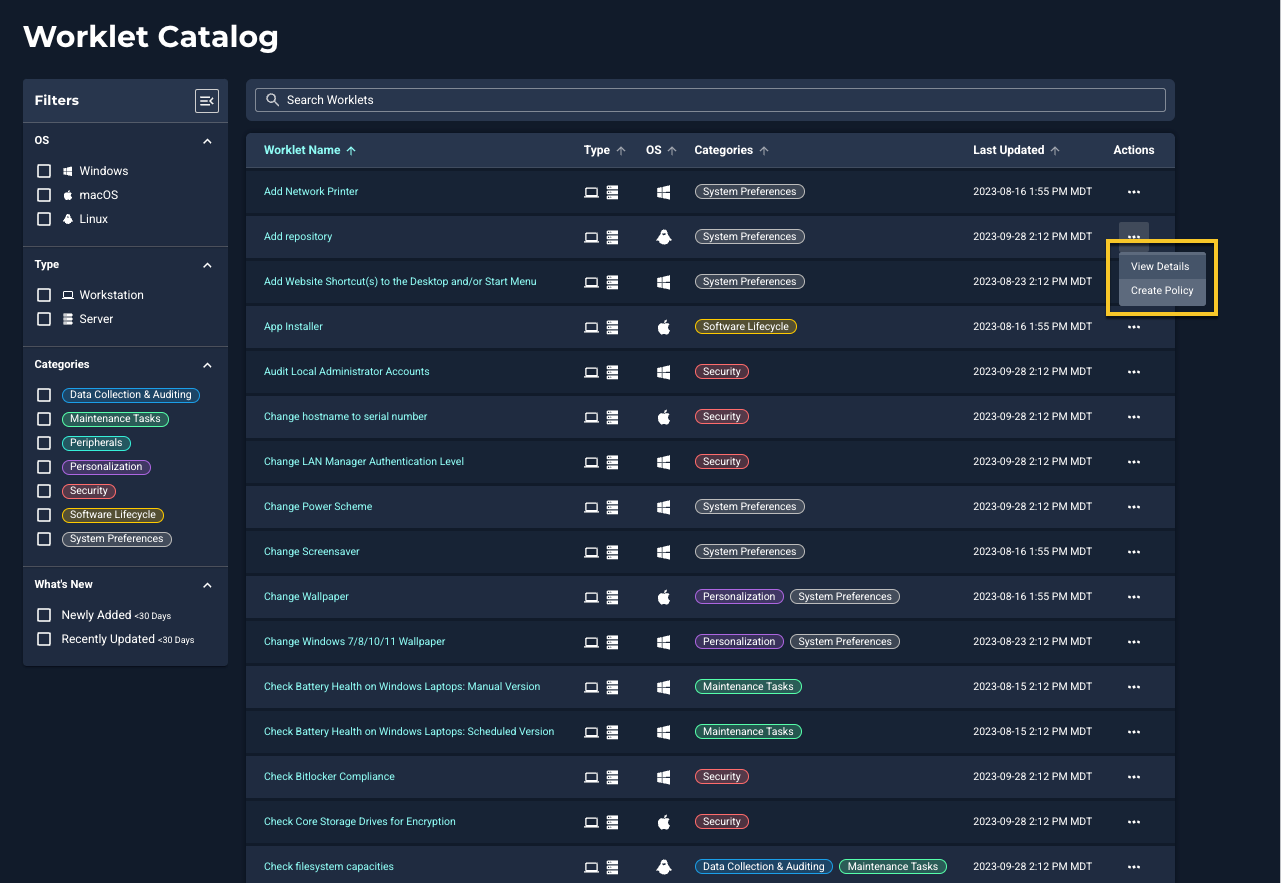
You can access the catalog from the Automate → Worklet Catalog page.
|
Worklet Catalog Table |
Description |
|---|---|
|
Worklet Name |
Name assigned by Automox |
|
Type |
This can be a workstation or server |
|
OS |
This is the operating system that the worklet is intended for |
|
Categories |
Worklets are organized into categories: Data Collection & Auditing, Maintenance Tasks, Peripherals, Personalization, Security, Software Lifecycle, System Preference |
| Access Level | Select from either Base or Premium |
|
Last Updated |
The time and date when the worklet was last updated |
|
Actions |
Possible actions:
|
Search the Worklet Catalog
From the Workout Catalog page, you can use the search bar to search for a worklet by a variety of terms.
Using the filter panel
The filter panel is made up of various options to fine-tune your search. When you select any of the individual filters, a number in parentheses shows how many are selected. You can clear selections individually, or select Clear All. The panel can also be collapsed. These settings are saved in the URL. When you navigate to other pages and return to the page, your settings are maintained.
You can select from the following options:
- OS: Filter by supported operating system.
- Type: Filter by environment, such as workstation or server.
- Categories: Filter by worklet category.
- Access Level: Filter by Base or Premium worklets.
- What’s New: Filter to show newly added or recently updated worklets.
Using the search bar
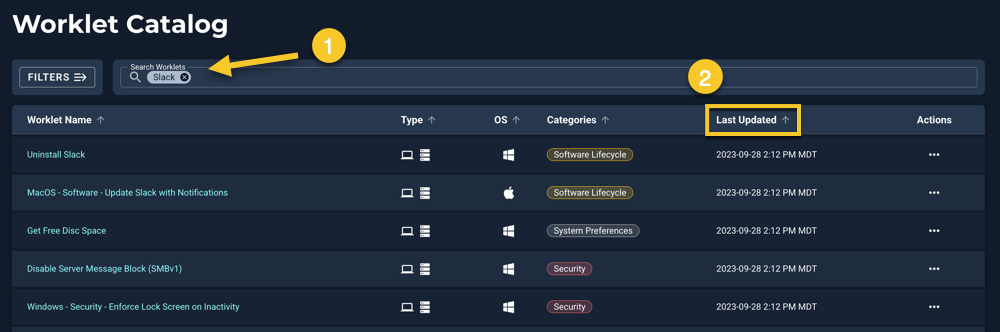
You can enter the partial names and multiple search items to refine results. You can search by the following:
- Name
- Description
- Operating system
- Keyword
Additional behavior:
- Fuzzy search for Name: Searching by Name supports fuzzy search and takes misspellings into consideration.
- Wildcard match for other fields: Searching by description, OS, or keyword uses a wildcard match.
- Sorting: Select a column heading to sort by that column. If you select a sorted column a third time, sorting turns off and results revert to relevance order.
- Relevance: Results include matching data and close matches and are returned by relevance to the search terms.
You can also browse the growing list of worklets on the Automox website (Browse Worklets).
Viewing Details
You can view the details of a verified Automox worklet in either of the following ways:
- Select the worklet name in the table to open the details view.
- Open the Actions menu for the worklet and select View Details.
In the Worklet Details window, select Code Preview to open the evaluation and remediation code details for the selected worklet. You can scroll through the code to view the details.
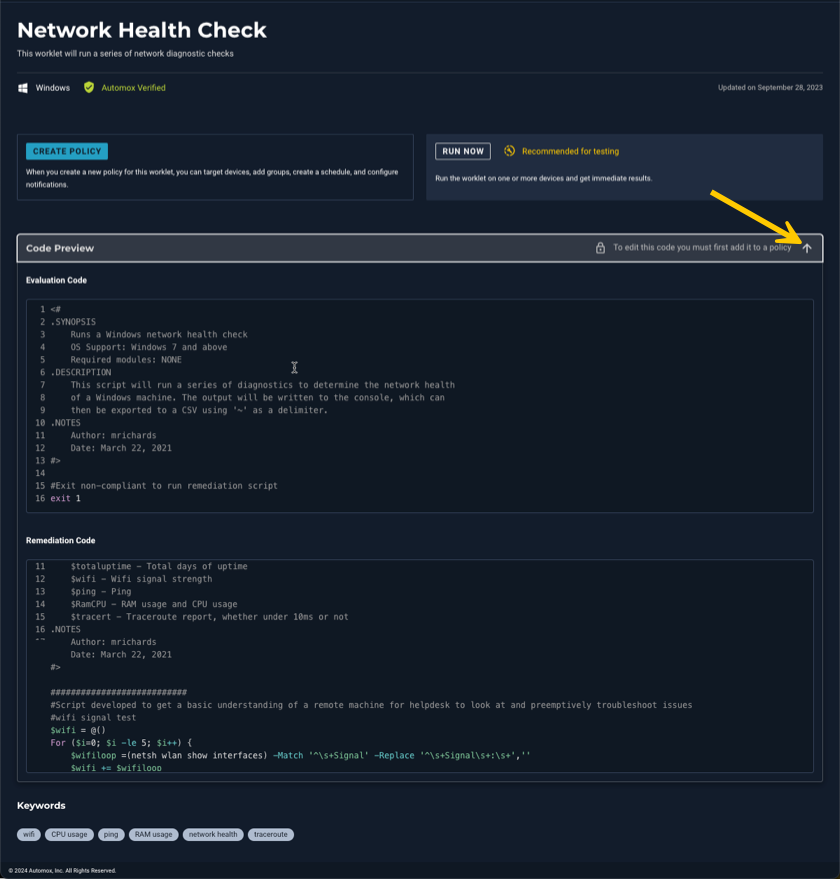
To edit the code presented in a worklet from the catalog, you must first add it to a policy. Click Create Policy. The Create Worklet page opens and you can make the desired changes, such as:
- Configure device targeting: Use filters to target a collection of devices.
- Edit code: Modify evaluation or remediation code.
- Set a schedule: Define when the policy runs.
- Configure user notifications: Set the message and behavior shown to device users.
For additional help, please submit a support request through the customer portal.
